

“Fail fast” is clearly an oversimplified sound bite.
Once attributed to the life practices of those typically viewed as successful.
While at first it halted us with its irony- how does failure lead to success? It fell short of addressing the complex nuance many face in the art of decision making.
From my view it conflicted with my interpretation of the responsibility and the privilege of being the decision maker.
Somewhere over my years, I associated making a decision with deliberation and reflection. More importantly the mindful consideration of the impact on all parties involved required extensive reflection.
It does not.
At least those traits are not prerequisites to successful choice.
Decisions can be made without much thought. Alternatively choices can also be arrived upon slowly, with an in-depth drill down of the Pro/Con ratio.
Only one thing about choice making is certain- neither approach guarantees the result.
The decision maker can end up actually being ‘right’ with what was thought to be the worst choice at the time, just as easily as the right choice may result in a more challenging experience.
In both love and business often a well thought strategy overlooks a critical detail or faces an unplanned response.
I had a friend who when I sought his counsel on a particularly stubbborn challenge would say “you can always flip a coin”
Really? How could the process be limited to the mathematical reality that a choice made at center field, as a coin flips through the air, always only has a fifty percent chance of being right,.
He would say, choices “always only yield at least two outcomes.“
First, with the experience resulting from the choice made.
Second the evolution of our talent in making choices.
This seemed also too simplistic. Deliberating over decisions, I have often mistaken the degree of intelligence with the depth of reflection.
While wisdom is unquestionably result of experience, the talent to recall past similar circumstances is part of that wisdom. Yet that wisdom is enhanced when later one fully accepts that, past choices are always limited to situational variables that occurred in the past.
Who we were at the time, what we knew, what the environment was that existed, and who we were dealing with, all have been weathered by the passage of time since we last faced what looks to be the same choice today.
For example when I was twenty-something working with my father I sat painfully as he took what seemed like eternity to decide about something that was soclearly a ” no brainer’ from my youthful perch.
I have also watched my son labor over choices that from the perspective of the years behind me, reveal to me the actual significance of the choice.
I benefit from the awareness that no matter what outcome the choice made will be “right” eventually, in that he has the gift of time to learn and recover the vast majority of the choices he faces.
I have seen my own decision-making process morph as I shifted from the pursuit of acquisition to the confirmation of the personal brand I wish to serve as my leave behind.
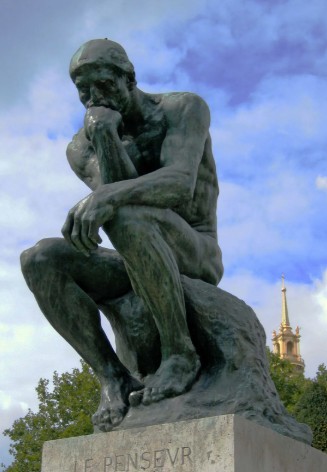
At first the big decisions left me sitting statue like meditating over my work like Dante, as reflected in “The Thinker”. I was consumed with the repeated review of every possible scenario deluded by the belief that there was only one perfect outcome, that might free him from future regret.
Occasionally, the time I indulged in the ping pong process of decision making resulted in the circumstances changing. Taking so long take advantage of an opportunity that the opportunity itself changed.
These deliberations only resulted in adding more pressure to subsequent choices
I remained condemed to suffered the paralysis of analysis, until I became aware that whatever the outcome ,only my perspective can shift, not my ability to choose what I see .
Then there is the truth that not making a choice is in fact a choice. However it is always a costly one in that it is a choice that strips us of our power and more importantly of the potential of life experience.
When we delay and delegate the experience of decision making, we deny and discharge ourselves from the sublime responsibility of defining our existence. We disregard the opportunity cost of the time, spent frozen with our chin resting on our balled fist in over contemplation.
For sure pausing to consider the possible outcome may have served some of us from the learning moment that comes with inserting a fork into a wall outlet. Yet with that said the old adage still rings true more often than not- “ He who hesitates is lost“.
We also lose when we blame the boss, the bottle, our partner, our lawyer or the weather, as we completely elimimate our shot at self determination. At worst we never learn from choices that didn’t go as planned. At best this approach robs us of any opportunity to take credit for the choices we made that worked the way we had hoped.
Soon this impacts our choice making self talk. When a choice goes favorably, we call ourselves lucky, yet when a choice fails to meet our hopes, we beat ourselves up.
So why do we make the choice to take so long to choose? I suspect because somewhere, we have learned that when it comes to choice-making, slow is smart and quick is rarely a safe bet.
In the end, is it making the right choice that truly makes us wiser or is it what choice making teaches us?
The answer depends on the view of who is judging the choice made.
If the observer is amongst those in our entourage, it may be the former.
Conversely if the observer within our selves, it will always be the latter.
So perhaps the highest skill we need to learn is not the one we were taught in school, not the ability to pick the right letter on from a multiple choice.
Perhaps the talent we are best served by developing, in the face of life’s endless choices, is the ability to discern what the choice gave us, intead of what it cost us.
 Making a better past